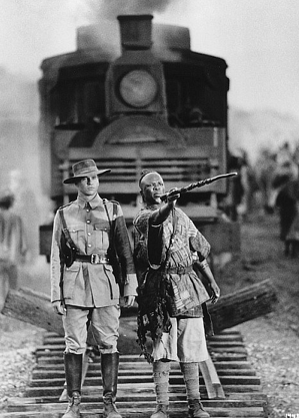
Col. Patterson with Samuel on the train tracks that cross Tsavo.
|
Critic Overview There
are over a hundred IMDB reviews for The Ghost and the Darkness. The
majority of these critic reviews are positive. The viewers enjoyed the
fast paced, attention-grabbing/ Hollywood aspect of the film. The
critics did not seem to have any prior knowledge of the Tsavo man-eaters
and thoroughly enjoyed that the film is based on real events. Hollywood
portrays the lions in the film with full manes. When most people think
of an African lion they picture a lion that would resemble “Mufasa” the
character from the Lion King. In fact Tsavo lions are a breed of lion
where even the male lions do not grow fur around their neck. Here
is a quote from one of the critics on IMDB “The movie is definitely
helped by its environment and atmosphere. The beautiful African land
serves as a perfect backdrop for the movie”. The critics are constantly
raving about the amazing African environment that Hollywood has created.
In reality, Africa shows very little resemblance to the one depicted in
the film. For instance, there is a scene that shows many different
animals running through the African Safari, this type of animal activity
does not happen in Kenya. Michael
Douglas’s character is entirely fictional. The writers of the movie
created his character to bring more drama and create a more American
appeal for the audience. |
Quotes From the Critics"In an attempt to show the lions as evil, director Stephen Hopkins
("Blown Away") goes all out, flooding the soundtrack with loud growls,
which are usually followed by the sounds of chewing, screaming and
more chewing". -Mick LaSalle, San Francisco Chronicle.
"A scenery-chewing Michael Douglas is the highlight of this passable landlocked variation of Jaws." -Chuck O'Leary, Fantastica Daily
"When the movie sticks to fact, the result is a hypnotic spectacle". - Peter Travers, Rolling Stones
Environmental Overview
Like
the rest of Hollywood, The Ghost and the Darkness propagates the same
African stereotypes about the environment. The filmmakers show the East
African environment in several different ways, varying with the mood
they want to portray. Very rarely, however, do they focus on actual
Africans, or the realities of 19th century colonialism. Though the film
is based on James Patterson’s autobiographical account of these events,
it has been westernized to fit with our cultural expectations and
extreme ignorance of African history. The autobiography itself is
exaggerated and then modified to fit into Hollywood form. The
movie contrasts England versus Africa in the opening scenes. As
mentioned in the film clip analysis, the shot of the steamy London dock
immediately transitions into the scene of the crowded African market,
thereby making it impossible for the viewer to miss the comparison.
These two urban environments are vastly different. London’s bustling
gentlemen donned with bowler hats, big stone buildings rising up, and
tall ships billowing steam across the docks suggests a thriving economy
and a “civilized” country. On the other hand, the African market that
Patterson walks into has a different chaotic and busy tone. This market
is full of the noise of many different vendors of all ethnicities trying
to sell their wares in a localized economy. Even though these scenes
take place in an urban environment, they still present some of the same
tropes applied to rural environments, particularly the idea of the
exotic or sublime. Africa is clearly not what the Colonel is used to.
It is alien, provocative, exciting, and exotically beautiful, but at the
same time mysterious and possibly dangerous. These elements of the
environment are expanded on as the movie follows James Patterson to the
countryside. The
rural representations in the film are as exotic. The movie was filmed
on location in the Kenyan Tsavo National Park, and on the Songimvelo
Game Reserve, in Mpumalanga, South Africa. These stunning locales have
been some of the main influences on our media’s portrayal of Africa.
Since they are both wildlife parks, they are necessarily devoid of human
settlement. Since 1948, the lands have been dedicated to wildlife
conservation. During the 1890s, when The Ghost and the Darkness is set,
there were multiple cultures who used this area for grazing and
hunting. Nevertheless, the area outside of the Tsavo bridge camp is
shown filled with wild fauna, but lacking people (until Remington shows
up with a band of tribal warriors.
According
to National Geographic, the outbreak of Rinderpest left the lions with a
shortage of usual prey and prompted the real Tsavo Man-eaters to hunt
humans. Frequent human deaths then gave hungry lions a new food source,
as it is “estimated that a minimum of 80,000 people died annually along
the treacherous northern caravan routes” (National Geographic). Lions
are social animals, which create culture to pass on survival
strategies. Thus, man eating lions are not as uncommon as we tend to
think; even ones as notoriously cunning as the Tsavo man-eaters. By
learning and teaching others how to raid villages for humans, lions can
be exceptionally deadly to us. However, the 130 deaths that Colonel
Patterson recorded were exaggerated by about 100. "In
a few well-documented, localized incidents, man-eating appears to be a
learned behavior. Once lions establish a pattern and begin to prey
regularly on humans, they can pass it on to their offspring, along with
sophisticated strategies and techniques, such as never returning to the
same place two days in a row."(Gnoske)
Why the death toll was
inflated later on, nobody can be sure, but the most obvious explanation is the
great story it makes. It is the rugged individualistic theme of man taking nature
head on that has been so captivating to western audiences since these events
took place. There is one final element in the story that is particularly
fitting. It was the ivory trade that brought Colonel Patterson to Africa, just
as it was the ivory trade that likely turned these lions into man-killers. In
the film, it is implied these lions are spirits, who want to drive the whites
back home. It is never revealed outright whether this is the case or not, but
in a way they are: demons of the colonialists own creation.
Bibliography1. Rafaelle, Paul. "Man-Eaters of Tsavo." Smithsonian.com. N.p., n.d. Web. 17 Apr 2013. <http://www.smithsonianmag.com/science-nature/Man-Eaters-of-Tsavo.html>.
2. Gnoske, Thomas and Borzo, Greg. " Field Museum uncovers evidence behind man-eating; revises legend of its infamous man-eating lions." Eurekalert. Journal of East African Natural History., 14 Jan 2003. Web. 17 Apr 2013. <http://www.eurekalert.org/pub_releases/2003-01/fm-fmu011303.php>.
3. Pickrell, John. "Man-Eating Lions Not Aberrant, Experts Say." National Geographic. N.p., 4 Jan 2004. Web. 17 Apr 2013. <http://news.nationalgeographic.com/news/2003/02/0211_030211_tsavolions.html>. 4. Janssen, Kim. "Scientists restate Tsavo lions' taste for human flesh." Chicago Tribune.
N.p., 2 Nov 2009. Web. 17 Apr 2013.
<http://articles.chicagotribune.com/2009-11-02/news/0911010253_1_lions-restate-field-museum>.
5. LaSalle, Mick. "FILM REVIEW -- It's Hard to Sink Your Teeth Into `Ghost and Darkness' ." SF Gate .
N.p., 11 Oct 1996. Web. 17 Apr 2013.
<http://www.sfgate.com/movies/article/FILM-REVIEW-It-s-Hard-to-Sink-Your-Teeth-Into-2963330.php>
6. "The Ghost and the Darkness." IMDB. N.p.. Web. 17 Apr 2013. <http://www.imdb.com/title/tt0116409/?ref_=fn_al_tt_1>.Travers, Peter. "Movie Reviews Only ." Rotten Tomatoes. N.p., 12 May 2001. Web. 17 Apr 2013. <http://www.rottentomatoes.com/critic/peter-travers/>.
7. O'Leary, Chuck. "Listing of all reviews and article ." Rotten Tomatoes. N.p., 12 May 2001. Web. 17 Apr 2013. <http://www.rottentomatoes.com/critic/chuck-oleary/>. 8.Adams, Jonathan S., and THomas O. McShane. The Myth of Wild Africa Conservation Without Illusion. New York : 1992. Print. <http://books.google.com/books?id=GWtWDN0BWt0C&printsec=frontcover 9. Hopkins, Stephen, dir. The Ghost and the Darkness. Writ. William Goldman. Vision Distribution , 1996. Film. 23 Apr 2013. <http://www.imdb.com/title/tt0116409/>. 10. Stoffel
, Tim. "The Ghost and the Darkness." . N.p., 02 Jul 2002. Web. 23 Apr
2013. <http://www.lionlamb.us/tsavo/ghostdar.html>. | |
|